ESPN.com wrapped up its All-Time #NBArank list of the 100 greatest players in league history on Wednesday. A
heavily scrutinized list, ESPN’s expert panel gave almost no method to their
madness, outside of “basing their voting on peak performance and career value.”
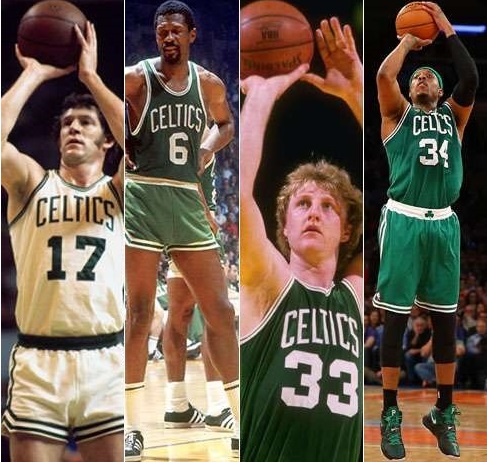
The rankings were none too kind to Larry Bird (Ranked No. 6), Bill Russell (No. 7), John Havlicek (No. 28) and Paul Pierce (No. 45)—widely considered
the four greatest players in the history of the renowned Boston Celtics franchise.
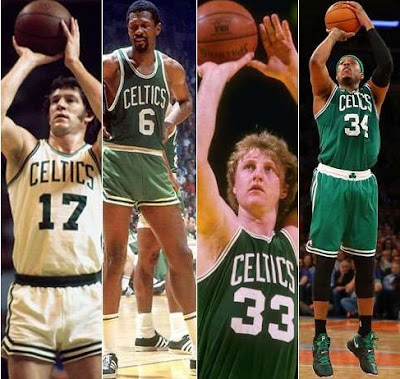 |
| The Mount Rushmore of the Boston Celtics Franchise (John Havlicek, Bill Russell, Larry Bird and Paul Pierce from left to right) all deserved a higher placing in ESPN's All-Time Rankings. |
Understanding the
Truth: Pierce Severely Underrated in Rankings
Pierce, the Celtics’ franchise
all-time leader in three-pointers, free throws and steals, was curiously ranked
behind Bob Cousy (No. 39) and Kevin McHale (No. 31) among Celtics’
greats. Pierce—a 10-time All-Star and one-time NBA Finals MVP—ranks second in
scoring in franchise history, fourth in PER (player efficiency rating), second
in Offensive Win Shares, fourth in Defensive Win Shares, third in overall Win Shares
and second in Value Over Replacement—all marks above both Cousy and McHale.
Cousy’s dominance cannot be denied:
He led the league in assists eight times (1953-1060), appeared in 13 All-Star
Games (1951-1963) and won a league MVP (1957). The 6-time NBA champion
dominated an era devoid of substantial guard talent. Most pundits surmise that
his talents would not have translated to today’s NBA game, unlike other Greats
from his era. And while Cousy won six titles (1957, 1959-1963), he was never
the best player on any of those teams—that honor belonging to none other than
Bill Russell.
Similar to Cousy, McHale won more
titles than Pierce—but was never the best player on any of his three
championship teams. McHale even merged into a reserve role—albeit he did it in
extraordinary fashion, becoming arguably the greatest sixth man (he won Sixth
Man of the Year in consecutive years from 1984-85) in league history—for the
Celtics’ titles in 1984 and 1986. Pierce, meanwhile, was in fact the best player
on the 2008’ title team (though Kevin
Garnett had a greater impact on the team’s regular season success) and was
the face of the franchise for each of the 15 seasons he spent in Boston.
The biggest disrespect towards
Pierce, perhaps the most clutch player of his era, came in the rankings among
small forwards. He failed to make the top-10 for the position. Pierce, who ESPN
selected as the 11th best small forward, ranked behind Dominque Wilkens (No. 44, 10th
among SFs), James Worthy (No. 43, 9th
among SFs), and Rick Barry, (No. 37,
8th among SFs) to name a few.
Wilkens, who failed to reach the Conference Finals in his 16-year career, has
scored the 12th most points in NBA history, ahead of Pierce
(currently 16th). But Wilkens—along with Worthy (98th
all-time in scoring) and Barry (60th all-time in scoring)—ranks behind
Pierce in every other significant statistic—rebounds, assists, free throws,
three-pointers, steals and blocks.
Barry and Wilkens each own an NBA
scoring crown, but it should be noted that the season scoring champion for the
league is measured in points per game—not total points. This in itself is
ridiculous because players should be rewarded for staying healthy and playing
as many games as possible. (Imagine the MLB giving the home run crown to the player with the most homers per contest, instead of total home runs. ) Pierce led the NBA in
total points scored in the 2001-02 season but failed to win the scoring title as
Allen Iverson averaged more points
per contest.
The lack of postseason success for Wilkens
should omit him from the top-10 of small forwards. Worthy owns three rings, but
was the third piece in the “ShowTime” Los Angeles Lakers dynasty of the 1980s behind Magic Johnson and Kareem Abdul-Jabbar. The tandem of Magic and Kareem did the heavy lifting for the championship teams (1985, 1987, 1988)
that Worthy was a part of.
Barry enjoyed roughly the same postseason
success as Pierce—winning a title and a Finals MVP—but putting him ahead of The
Truth feels wrong. As previously noted, Pierce ranks ahead of Barry in every
statistical category, and furthermore, was more of an elite one-on-one player.
In addition, Pierce, a criminally underappreciated defender, is No. 22 all-time in defensive win shares—third among
small forwards behind only Scottie Pippen (No. 16) and Havlicek (No. 12).
 |
| Paul Pierce's (ranked No. 45 overall by ESPN) omission from ESPN's top-10 small forwards of all-time is puzzling, to say the least. (Jim Rogash/Getty Images) |
Other retired players that were baffling to see ranked ahead of Pierce, who is 4th all-time in three-pointers (most among forwards), included Bill Walton (No. 42) and George
Mikan (No. 33). It’s too soon to rank the young active Greats—Chris Paul (No. 29), Stephen Curry (No. 23) and Kevin Durant (No. 22)—so high this
early in their careers. Assuming "CP3" attains some shred of postseason success,
all three are well on pace to establish a more eminent legacy (particularly Curry)
than Pierce.
Hondo’s Greatness
Undervalued
Havlicek ("Hondo") is the all-time
leading scorer for the most successful franchise in NBA history. An eight-time NBA
champion (1963–1966, 1968–1969, 1974, 1976) and 13-time All-Star (1966–1978),
Havlicek is 13th on the league’s all-time scoring list (LeBron James will soon pass him). A one-time
Finals MVP (1974), Havlicek’s array of talent goes beyond scoring. He made five
NBA All-Defensive First Teams (1972-1976) and is the all-time leader in
defensive win shares (74.09) among small forwards.
Despite the aforementioned accolades,
Havlicek is found as just the seventh-best small forward in league history, according to ESPN. Pippen (No. 25, 6th among SFs) was a masterful defender (10-time
NBA All-Defensive First Team) and the ultimate sidekick to Michael Jordan.
Havlicek, too served as a complimentary player, as Russell was the spearhead of
the Celtics’ 11 titles from 1957 to 1969. The difference between Pippen and
Havlicek lies in offensive prowess. Havlicek was a far more effective two-way
player and the second greatest scorer of his era (Wilt Chamberlain owns that era's honor).
Elgin
Baylor (No. 24, 5th among SFs) somehow landed above Havlicek in
the rankings. An athletic freak, Baylor ranks third in points per game, behind
Jordan and Chamberlain. He is one of two small forwards (the other being Larry
Bird) to finish with 10 NBA First Team honors. Baylor, though, never accomplished
ultimate postseason success. The championship-deprived Baylor also failed to
capture an MVP trophy.
Baylor did reach five NBA Finals
before Chamberlain joined the Lakers in 1968, losing each time to Russell and
Havlicek’s Celtics. The tandem of Chamberlain and Baylor reached three Finals
together, losing twice to the Celtics and once to the New York Knicks. Chamberlain eventually won a title with the Lakers
in 1972—the season after Baylor retired. Baylor finished his career with an
egregious 0-8 record in the Finals.
The most shocking ranking for small
forwards has to be Kevin Durant (No. 22, 4th among SFs). In the
midst of just his 9th NBA season and still yearning for his elusive championship, Durant has no business being ranked ahead of Havlicek. If Durant can
win a title, he can certainly earn his current status on ESPN’s
list. The 27-year-old has four scoring titles—third-most behind only Jordan and
Chamberlain—and an MVP crown already. Durant himself says it’s too early to be ranking him this high. Let’s wait five years or so and reevaluate his place among NBA
Greats.
Bill Russell Left Out
of Top-5…How?
The greatest winner in the history of the four
major American sports, Russell was placed seventh in ESPN’s all-time rank. Winning
a whopping 11 titles, Russell carved his legacy from the late 1950’s onward to
the entire 1960’s. Second all-time in rebounding, Russell won five MVP awards—second-most in NBA history.
Russell is the greatest Celtic of
all-time and should be ranked above Bird (No. 6). Russell was the best player
in the league for the entirety of his 13-year career. Bird’s higher ranking on
the list is likely accounted for his ability to score, distribute and consistently
come up with clutch, late game heroics in an unprecedented manner. Since the
two Celtics Greats played in a different era, the argument is at least plausible.
How, though, could the ESPN panel
rank Chamberlain ahead of Russell? Yes, Chamberlain accumulated more career points
(a remarkable 30.1 points per contest) and rebounds (an otherworldly 22.9
rebounds per game). And sure, he was able to post a 100-point scoring effort
and lasted two seasons longer than Russell. But Russell’s teams owned
Chamberlain’s—particularly in the playoffs. Russell won eight of the nine
head-to-head playoff series, including two NBA Finals (1964 and 1969). Russell
also dominated the regular season matchups, winning 82 of the 142 contests
against Chamberlain. Chamberlain put up the gaudy stats, but it was Russell who
almost always came up on top in team wins.
 |
| Bill Russell Owned the Head-to-Head Matchups Against Wilt Chamberlain. (Kevin Regan/Getty Images) |
And is it really fair to rank both Magic and
Kareem ahead of Russell? The two got the pleasure of playing alongside one
another to wreak havoc against the league for over a decade. But the reality is Magic’s status has to be downgraded a bit because he was in
the presence of Kareem, who owns a record six NBA MVPs.
Kareem over Russell—maybe? But Magic
ahead of Russell is blasphemy. Russell’s large edge in titles (11-to-5) is a clear difference maker. Both players were unstoppable in their facet of
the game: Russell dominated the glass, while Magic manned the floor with an
incredible vision and passing expertise. But the biggest difference is Johnson played in the shadow of Kareem.
Going forward with the consistent
theme that players shouldn’t be evaluated until their career is coming to a close
or completely finished, LeBron James simply cannot be ranked ahead of Russell at this
juncture. Russell should be ranked no worse than No. 3 as only Kareem and
Jordan can compare to his greatness.
Larry Legend Deserves
to Top Magic and Wilt in All-Time Rank
Larry vs. Magic is the most
celebrated player rivalry in the history of the league. The two guided the two
most decorated franchises for a decade-plus, restoring popularity in the NBA.
Magic got the best of Larry in the postseason, winning two of the three NBA
Finals showdowns. That alone, though, does not make Magic the better player.
While Magic was able to play
literally every position on the floor, Bird was the more dynamic force. Bird
was the far better scorer and featured an elite outside shooting range,
something Magic did not possess. A four-time league assist leader, Magic was a
whiz when it came to collecting steals. He led the league in steals in consecutive
seasons (1980-1981, 1981-1982) and ranks 20th all-time in steals.
But it was Bird who was the superior defender, making three All-Defensive
Second Teams. Magic never made an All-Defensive Team.
 |
| Larry Bird versus Magic Johnson remains the most illustrious player rivalry in NBA history. (Andrew Bernstein/Getty Images) |
Magic and Larry each won three NBA
MVPs. Magic has the edge in titles (5-to-3) and Finals MVPs (3-to-2). But Bird
had something that Magic lacked: the ability to take over any game in a moment’s
notice. Johnson was an above average scorer and an elite passer but Bird’s
combination of scoring and distributing was far more tantalizing. And with the
game on the line, no player was more reliable than Bird with his unmatched
clutch intangibles.
Bird should be ranked no worse than
No. 5 (he could be placed fourth and ahead of LeBron for the time being). Wilt’s
postseason failures against his respective rival, Russell, should place him a notch below Bird, who thrived in the postseason.