Friday, July 17, 2015

Boston Red Sox 2015 All-Star Break Grades: Starting Rotation

Clay Buchholz
In his first seven starts, Buchholz’s ERA inflated to 5.73. But he looked like an ace in his next 10 starts, posting a 1.99 ERA while helping the Boston Red Sox stay in striking ground of the mediocre AL East race. But the often-hurt Buchholz (7-7, 3.26 ERA) landed on the disabled list again and there is no telling if he will be able to regain his form in his return to the mound.
Grade: B

Rick Porcello
There is no bigger disappointment in baseball than Porcello. Expected to fortify an ace-less Boston rotation, Porcello (5-9) owns the highest ERA (5.90) in the American League. The right-hander signed a four year, $82.5 million contract extension before the year began and has rewarded Boston with his worst year of his career.
Grade: F

Eduardo Rodriguez
The 22-year-old left-hander who was acquired in the trade that sent Andrew Miller to the Baltimore Orioles last July has looked dominant in seven of his nine starts. If his two horrific starts—June 14 (9 ER in 4.2 innings in loss versus Toronto Blue Jays) and June 25 (6 ER in 2.2 innings in loss to Orioles)—were excluded from his stats, Rodriguez would own a 5-0 record with a 1.22 ERA. Rodriguez (5-2, 3.59 ERA) looked sharp in his first start against the New York Yankees, picking up a victory in a contest in which he surrendered only two runs in 6.2 innings.
Grade: B+

Wade Miley
Miley’s meltdown against the Orioles showed he was an emotionally weak player. Miley’s 3.39 walks per nine innings rate ranks sixth worst in the league. He hasn’t been an innings-eater as advertised but has managed to salvage his season with decent numbers at home, particularly against left-handed batters.
Grade: C-

Joe Kelly
Kelly asserted he would win the American League Cy Young before the season began. He is currently stuck in the minors.
Grade: F

Justin Masterson
Not much was expected of the former All-Star this season. Nonetheless, the Red Sox had hoped for more than what Masterson—who spent half of the season in the minors/on the disabled list—provided in nine woeful starts. Masterson, who owns a horrific 6.00 ERA, will look to stick on the major-league roster as a long reliever.
Grade: D

Steven Wright
The 30-year-old knuckleballer looked decent in four starts (11 appearances overall) for the Red Sox this season. Wright (3-2, 4.15 ERA) should see more MLB action in the second half of the season with Buchholz on the disabled list for an undisclosed amount of time.
Grade: C+

Thursday, July 16, 2015

Boston Red Sox 2015 All-Star Break Grades: Front Office/Management

John Farrell and Ben Cherington have overseen Boston's disastrous first half of the season. (Barry Chin/Boston Globe)
Owner John Henry
Henry was the leading force behind the signings of Hanley Ramirez (4 years, $88 million) and Pablo Sandoval (5 years, $95 million) this offseason, and right now both deals look like duds for the Boston Red Sox. Henry pushed for the two free agent splashes in an effort to increase ticket sales and TV ratings. The Red Sox may be selling more tickets than last year's last-place catastrophe but the team is back in the basement in the AL East thanks to the less-than-stellar performances by their lucrative free agent expenditures. Sandoval is batting just .265 with limited power (7 HRs and 30 RBIs) and has the second-worst fielding percentage among starting third basemen in the American League. And lets not forget he was caught liking a photo on Instagram mid-game. Ramirez, meanwhile, has looked awful in the outfield, runs the bases like a Little League player and managed just one RBI in the month of July. Ramirez has cranked 16 home runs and has been strong at the plate of late, but signing him was a huge risk because of his limitations in the field. He should be a full-time designated hitter—a slot that won't open up until after David Ortiz (who refuses to play first base on a regular basis) retires.
Grade: D-

GM Ben Cherington

As noted above, it was Henry who wanted to bring Ramirez and Sandoval to town. Nonetheless, Cherington is responsible for the trade that netted Joe Kelly and Allen Craig, both players that have been subjected to the minor leagues . Rusney Castillo, the so-called Cuban sensation who received a seven-year, $72.5 million contract this winter, was sent back to the minors after posting an awful slash line of .233/.263/.288. Castillo's woes fall on Cherington, who expected the Cuban outfielder to jumpstart a Red Sox offense that was horrific in 2014. But Cherington's most inexcusable mistake? Signing Rick Porcello to a four year, $82.5 million contract extension that runs through the 2019 season before the right-hander threw a single pitch for Boston (and yet the team refused to give Jon Lester the money he deserved during contract negotiations last regular season). The mid-season pickup of Alejandro De Aza has been a gem and the development of youngsters Mookie Betts, Xander Bogaerts, Eduardo Rodriguez has been encouraging, but too many of Cherington's moves have backfired for the Red Sox.
Grade: C-
Manager John Farrell
The Red Sox players have lost track of outs, Sandoval used his bathroom break to go on Instagram and the team shows no willpower against adversity. All of the aforementioned issues fall on Farrell. He also said he "respected" Wade Miley for throwing a tantrum on the mound in a game the disappointing left-hander crapped the bed in a loss against the Baltimore Orioles. From afar, it appears Farrell has lost complete control of the locker room.
Grade: D

Sunday, June 28, 2015

John Lackey for Joe Kelly/Allen Craig Trade has had Nightmarish Results for Red Sox

            The trade that sent John Lackey to the St. Louis Cardinals for Joe Kelly and Allen Craig looks shoddier by the day. The Boston Red Sox dealt Lackey—the No. 2 starter in its World Series championship team in 2013—at the trade deadline in last year’s turbulent season with the aim of building for the future. However, neither Kelly nor Craig has yielded any positive results for Boston.
             Kelly (2-5) boldly proclaimed he would win the American League Cy Young this season. Kelly's prediction has burnt into flames. The right-hander was optioned to Pawtucket following another dismal performance in Tuesday night’s loss—surrendering five runs on eight hits in just 3.2 innings of work in the 6-4 defeat at the hands of the Baltimore Orioles.
Safe to say Joe Kelly won't be winning the AL Cy Young this season. (Joe Robbins/Getty Images)
            Now holding the third-worst ERA (5.67) in the American League, Kelly has been demoted to the minors—an embarrassing moment for the 27-year-old who grabbed a headset from WEEI’s broadcast setup during the Red Sox’s Winter Weekend at Foxwoods and spontaneously announced, “I want your listeners to know, I’m going to win the Cy Young this year. Just letting everyone know so when I win it you heard it here first.”
            Instead of competing for the Cy Young race, Kelly has been shipped down to Triple-A, where his biggest enjoyment could be sharing a dugout with his longest-standing teammate and fellow disappointment, Allen Craig. The first baseman/outfielder, Craig hasn’t seen action in the big leagues since May 9. He played woefully for the Red Sox in his short stay in the majors this season, batting .135 with one home run and a pair of runs batted in.
            Craig has seen a steep decline since being a major factor of the St. Louis Cardinals’ championship season in 2011. That regular season he hit 315/.362/.555 with a .917 OPS. He hit four home runs in the postseason—three coming in the World Series against the Texas Rangers, including one in the title-clinching Game 7 victory for St. Louis.
            The following season Craig hit 22 home runs and recorded 92 RBIs. He earned a five year, $31 million contract in the offseason. Craig made his first All-Star appearance in 2013. He batted .375 in the World Series against Boston.
            Nagging foot problems, though, have crippled his once-promising career. Craig hit a combined .237 for the Cardinals before being traded to the Red Sox last season. As a member of the Red Sox, he started just eight games and batted .135 in 59 plate appearances.
            Since his demotion to Triple-A this May, Craig has hit .290 with a .429 on-base percentage, .403 slugging percentage and .832 OPS. But the right-handed hitter—once known for his power at the plate—has registered only eight extra-base hits (five doubles and three homers). Manager John Farrell still believes Craig isn’t ready to return to the majors, a concerning sign for a player that is under contract in Boston through 2017, and making $25 million in that time span.
            It’s anyone’s guess as to which player has the ability to turn his career around. Skepticism has begun to arise among league executives and scouts with regards to Kelly's and Craig's ability to ever contribute on a regular basis for a MLB team. The Red Sox, though, maintain their hope that both Kelly and Craig can produce for the team in the near future. Lackey certainly has been productive since Boston washed their hands of him. The 36-year-old right-hander posted a 3.46 ERA in two starts for the Cardinals in the 2014 playoffs and currently owns a 3.35 ERA.
            Some believe Kelly has a better chance to right his career ship. He is better off as a power pitcher that relies on his velocity, rather than operating as a finesse hurler. His inconsistencies, however, have led many to believe he won’t amount to anything more than a mediocre No. 4 starter at best. There are others who surmise Craig has a better chance of turning his two-year slump around because of his past success. The detractors of Craig, however, will point to his career demise since his foot issues arose.
           The optimistic Red Sox fans—if any still exist—hope both Kelly and Craig become effective MLB players. As of now, the Lackey for Kelly and Craig swap has been an utter failure for the Red Sox, who traded for two players currently in the minors in exchange for a veteran who has pitched in two decisive World Series contests. 

Tuesday, June 23, 2015

George Karl's Desire to Trade Star Center DeMarcus Cousins Part of a Growing Patern

            George Karl wants to run another superstar out of town. Karl, named head coach of the Sacramento Kings on Feb. 11, desires the team’s front office to part ways with DeMarcus Cousins via a blockbuster trade. According to a report from Yahoo Sports!/FOX Sports 1 NBA insider Adrian Wojnarowski, Karl is imploring the Kings brass to wash their hands of Cousins. Here’s a piece of Woj’s report:
            Karl has been recruiting Kings vice president of basketball operations Vlade Divac and multiple players on the Kings' roster to unite with him in making the case to owner Vivek Ranadive that Cousins needs to be traded, league sources said.
            Since the end of the 2014-15 season, Cousins has become aware of Karl’s campaign to move him – including teammates telling Cousins, sources said. All around the Kings and Cousins, there is a growing belief the coach-player relationship is irreparable. Trust is a constant theme with Cousins, and he’s been unable to build any with Karl, sources said.
            No one in the Sacramento organization – not coaches, nor players, nor support staff – wants to imagine the combustible scenario awaiting Karl and Cousins should the Kings try to reunite them in training camp.
            Cousins has had his share of detractors since entering the league. His defense, laziness and inability to coincide with the team's head coach have been criticized. Though Cousins is not a model player—at least in terms of his mental toughness and work ethic—the talented big man is not at fault for being unable to co-exist with Karl.
            A 24-year-old first-time All-Star in 2014-2015, Cousins emerged as arguably the NBA’s top center last year, showing signs of maturity in the process.  In fact, Divac gave the young center immense praise in March, saying Cousins is the most talented big man he has ever seen.
             "I've been in basketball a long, long time, and I have to say he's the most talented big guy I have ever seen," Divac said of Cousins, who recorded the third-most double-doubles this past season (47) despite missing 23 games due to injury/illness. "Shaq [Shaquille O’Neal] wasn't talented -- he was just strong. I was talented, but I wasn't strong."
            The burden of the failed player-coach relationship falls on Karl. The 2012-13 NBA Coach of the Year, Karl has a history of butting heads with his team’s alpha dog, so it’s no surprise he has quarrels with Cousins, who posted 24.1 points, 12.7 rebounds and 1.7 blocks per contest with a 25.2 player efficiency rating (PER)—the seventh-best mark in the NBA.
DeMarcus Cousins is coming off a career-year for the Kings, but head coach George Karl wants the star center out of Sacramento. (Troy Taormina/USA Today Sports)
             Karl is responsible for Ray Allen’s departure from the Milwaukee Bucks. Allen led the Bucks to the Eastern Conference Finals in 2001—losing to the Allen Iverson-led Philadelphia 76ers in seven games—but was dealt to the Seattle Supersonics at the trade deadline two seasons later.
            "It came too much to an abrupt end," Allen said of his Bucks career. "It still seemed like there was more to be done here. Ultimately, I think it was the whole George Karl relationship. We started butting heads and it ended up not working.”
            The United States men’s basketball team made the mistake of hiring Karl to be head coach of the 2002 squad. The US had an embarrassing sixth-place finish in the 2002 Olympics—the only time the US has failed to win the gold since the International Olympics Committee granted professionals the opportunity to participate in the Games in 1992.
            Naturally, Karl had a scapegoat for the team’s catastrophic performance in the 2002 Games. The victim was Paul Pierce, the Boston Celtics’ budding star who was coming off his most impressive season as a pro in which he led the league in points scored. Karl—who before the tournament began told Pierce he was the team’s best individual offensive player—called the young guard/forward a “selfish player.” He said Pierce’s defense was lacking throughout the entirety of the Games. Pierce did not take Karl’s comments lightly. Prior to a regular season contest between the Celtics and Bucks in November 2002, Pierce ripped Karl to shreds when asked what he learned from playing for Team USA.
            ''I learned not to go play USA basketball if George Karl is the coach,'' said Pierce.
            ''I don't think he's a players' coach, straight up,'' said Pierce. ''It wasn't only me, but a number of the players didn't respond to what he was saying or understand what he was trying to do. But me, I just play my part. I'm never going to question what he needs to do in practices, what he needs to do in games."
            ''We had a great coaching staff, [San Antonio's] Gregg Popovich [to name one assistant]. We had personalities on the coaching staff that you could get along with, but it was hard to read [Karl] at times, what he wanted out of certain people.''
            Need more examples of Karl butting heads with star players? Look no further than tweets from his former players, who all indirectly reference their former coach as a snake:
            If Cousins is dealt Karl will face an even longer road to rebuild the Kings, a franchise that has not made the postseason since 2006. The Celtics, Los Angeles Lakers, Denver Nuggets and Dallas Mavericks are licking their chops at Karl’s irrationality, while Cousins has taken to Twitter to express his emotions on his coach’s trade request—using a well-placed snake emoji:

Thursday, June 18, 2015

Lance Stephenson Trade Opens the Door for Paul Pierce to Join Los Angeles Clippers

                Doc Rivers doesn’t foresee Lance Stephenson starting at small forward for the Los Angeles Clippers in 2015-16. Stephenson, acquired from the Charlotte Hornets on Monday in exchange for Spencer Hawes and Matt Barnes, is expected to serve as a role player, according to Rivers.
             “I like that [Stephenson] can play multiple positions -- really 2, 3 and 1 -- because he’s a terrific passer,” Rivers, the Clippers head coach and Senior Vice President of Basketball Operations, told The Beast 980 on Wednesday. “I don’t know if I made the trade for him to be a starter, per se, I look at him really more to be a utility player that can come in and play literally three different positions for us. When you look at us, we needed toughness and more athleticism and we get that.”
            Stephenson had a disastrous 2014-15 campaign after signing a 3-year, $24 million contract with Charlotte last offseason. He averaged just 8.5 points, 3.9 assists and 4.5 rebounds last season, shooting a dreadful 17.1 percent from three-point territory. Stephenson, who led the league in triple doubles in 2013-14, fizzled out in Charlotte, never fitting in with the team’s offense and even recording some DNPs at the tail end of his woeful season.
            Rivers believes Stephenson, who will be 25 years old by the start of next season, has the best chance to right the ship for his career in a backup role in Los Angeles. With Barnes dealt in the trade and Rivers declaring Stephenson a bench player, who will start at small forward for the Clippers?
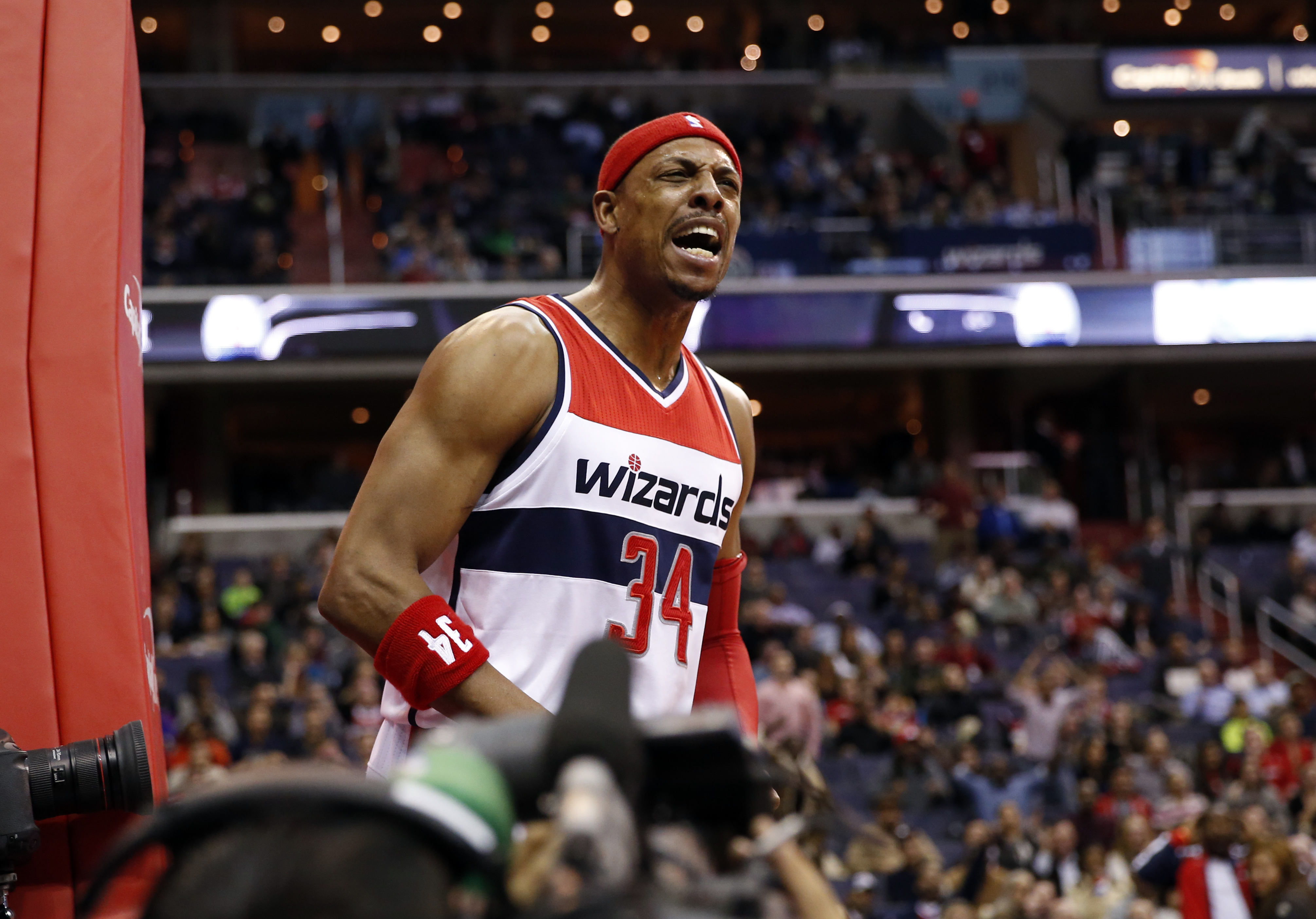
            Paul Pierce’s name has been thrown around in the Clippers' rumor circles of late. The future first ballot Hall of Famer is coming off a strong postseason for the Washington Wizards, averaging 14.6 points on just 9.9 shots per contest. He led all players in three-point shooting, hitting an incredulous 52.4 percent of his jumpers from behind the arc. Overall, he shot 48.5 percent from the field and 85 percent from the free-throw line. Pierce hit seemingly every clutch shot he attempted for Washington, most notably his buzzer-beating, “I Called Game”, dagger against the Atlanta Hawks in Game 3 of the Eastern Conference Semi-finals.
            Pierce and Rivers won a championship together with the Boston Celtics in 2007-08 and were a game away from winning the title in 2009-2010. Pierce has a $5.5 million player-option for the upcoming season with the Wizards and has maintained his happiness in D.C. throughout the year.
            Rivers coached Pierce for nine seasons, but could he persuade the small forward—who grew up in Inglewood, Los Angeles—to bolt to the Clippers? Rivers will have to convince Pierce that the Clippers have a better chance at winning the championship than the Wizards. The Clippers have the better team, but the Wizards play in the much weaker Eastern Conference. A title seems like a longshot for either team, but the Clippers present more of an upside for the upcoming season.
Doc Rivers will be courting Paul Pierce this offseason. (Alex Brandon/AP)
              Last offseason, Rivers chose to sign Hawes over Pierce—a terrible decision by a highly respected coach who has had his share of struggles adjusting to the role of player operations. While Pierce is not the type to hold grudges, joining Los Angeles seems less likely now than it did a year ago. 
              A Boston reunion is not out of the question for Pierce either. He wanted to finish his career with the Celtics and was devastated when he was traded to the Brooklyn Nets two summers ago. Yet Pierce has continued to have a strong relationship with the city and its fans, and the team’s immense improvement from this past year—coupled with their ample cap space to sign 1-2 top-tier free agents—could lure him back to Boston, where he played the first 15 seasons of his storied career. 

Monday, June 15, 2015

Cavs Cant Abandon Mozgov From Their Game Plan

            Timofey Mozgov dropped a career-high 28 points and corralled 10 rebounds in the Cleveland Cavaliers’ blowout loss to the Golden State Warriors in Game 4 of the NBA Finals at Quicken Loans Arena, but rode the pine for the majority of Sunday’s Game 5 defeat at Oracle Arena. Mozgov, Cleveland’s 7-foot Russian center, was nowhere to be found in the Cavs’ 104-91 loss, playing a grand total of nine minutes without a single point, rebound or assist recorded.
            "It's no disrespect to anyone, certainly not to Timo, who has done a great job for us," said Cavs head coach David Blatt, when asked why Mozgov's minutes were significantly reduced. "That's just the way that we played it tonight, and Timo will be back and he will not lose his way or lose his head just because he didn't play a lot tonight."
            Warriors head coach Steve Kerr made a genius move prior to Game 4 with his team facing a 2-1 deficit, inserting Andre Iguodala into the starting lineup to replace Andrew Bogut—who did not see any playing time in Game 5 and logged just three minutes in the prior contest. Recognizing his team could not go toe-to-toe in the rebounding department against the Cavs, he opted for a quicker lineup that could create better looking shots from the outside. 
            Kerr’s plan worked perfectly in Game 4, mainly because Iguodala shut down LeBron James. Mozgov was the lone bright spot for Cleveland in that contest. In Sunday’s defeat, James returned to form but the Cavs’ second-best player of the series, Mosgov, was left on the bench and unable to help his superstar teammate.
            Blatt has played into Kerr’s hands by sitting Mozgov. Outside of James, Mozgov is the only Cavalier the Warriors have struggled to guard. With Mozgov sitting, the Cavs’ depth—already brutalized thanks to season-ending injuries to Kyrie Irving and Kevin Love, both three-time All-Stars—becomes even more challenged.
            The Cavs need to play Mozgov and Tristan Thompson on the court together for at least some portions of Game 6. Thompson, the 6-foot-10 inch power forward who has thrived in the absence of Love this postseason, played almost all the minutes at center in Game 5. Though Mozgov and Thompson struggled alongside each other in Game 4 against the Warriors’ smaller lineup, the ferocious rebounding tandem should be given another chance in the Cavs’ must-win contest on Tuesday night.
            When Mozgov is next to Thompson, it gives the Cavs a colossal edge on the glass. It allows one player to focus on offense (while the other looks to grab an offensive rebound) without giving up much on the offensive glass. When Mozgov and/or Thompson sets a bruising pick on James’ man, it causes the Warriors’ biggest defender—in most cases Draymond Green in Golden State’s small-ball lineup—to step up on James, giving Cleveland the upper-hand.
            The reality, though, is that Thompson and Mozgov can no longer play the majority of the game alongside one another, like they had done in the previous two series. Golden State exposed multiple mismatches by using their smaller lineup to combat Cleveland’s bigs. Still, Mozgov seeing only nine minutes of action in Game 5 is ridiculous and that falls on Blatt. 
            The tandem of Thompson and Mozgov should probably play no more than 15 minutes together. The remaining minutes should be split equally—or at least close to equal—with Mozgov on the court and Thompson on the bench and vice versa. Unless one of the two particularly shines, the minutes should be (roughly) distributed evenly. Mozgov is just as big a reason, if not more, that the Cavs are within two wins of a championship as Thompson, and Blatt needs to recognize that before it’s too late. 

Friday, June 12, 2015

Kerr's Small Ball Decision Comes up Huge Thanks to Iguodala

                Needing a spark after losing consecutive NBA Finals contests, Golden State Warriors head coach Steve Kerr opted for ‘small ball.’ Kerr initially told reporters he had no plans to change the usual starting lineup of Stephen Curry, Klay Thompson, Harrison Barnes, Draymond Green and Andrew Bogut.
            “I lied,” Kerr said following the Warriors’ 103-82 thumping of the Cleveland Cavaliers in Game 4. “I don’t think they hand you the trophy based on morality. They give it to you if you win. Sorry about that.”
            Kerr’s deception worked to a tee. In came forward Andre Iguodala, out came Bogut for the starting five. Iguodala, who has thrived in the Finals, revved up the engine for a Warriors squad that had looked disheveled in their previous two consecutive losses. Aside from speeding up the pace of Golden State’s offense, Iguodala decelerated LeBron James’ otherworldly rhythm he had maintained for the first three games of the championship series.
            James had his worst game of the Finals, missing 15 of his 22 shots and going scoreless in the fourth quarter. He went 4-14 on possessions in which he was guarded by Iguodala. In addition to containing King James, Iguodala excelled on the offensive end, posting 22 points on 8-of-15 (4-for-9 from three-point range) shooting.
Andre Iguodala found a way to slow down LeBron James in Golden State's Game 4 blowout victory. (Bob Donnan/USA Today Sports)
            Going small was a major risk for the Warriors as they had been getting pounded on the glass by the Cavaliers’ Timofey Mozgov and Tristan Thompson all series. Kerr recognized Golden State was going to get beat on the boards regardless, so his decision to insert Iguodala was predicated on the notion that a small lineup would deliver better shots and a faster pace. Kerr’s gamble paid off. Golden State moved the ball quicker and found more open shots. The Warriors shot 46.8 percent (39-of-77, including 12-of-40 from three-point range) from the field, their highest of the season. Finally, the Warriors created penetration to the basket, and as a result, often found an open man in the corner.
            The lineup change limited Bogut to just three minutes of playing time. But it opened the door for David Lee, the former All-Star who had been riding the pine for most of the postseason. Lee, who had previously been in Kerr’s doghouse, was effective for the second straight game. He poured in nine points (3-of-7 shooting) with five rebounds and three assists in five minutes of play. Lee helped the Warriors bench outscore Cleveland’s reserves 19-7 in Game 4.
            Lee’s ability to thrive in the small ball lineup was a pleasant surprise for a Warriors’ bench that has underachieved these Finals. But Iguodala stole the show in a game Golden State needed to have facing a 2-1 deficit in the series. Iguodala handled the ball almost as much as Curry and yet committed only one turnover.
            Iguodala posted a plus-16 in the victory. James, meanwhile, managed a minus-15. Despite James’ providing three superhuman outings to open the series, his struggles with Iguodala—who saw by far his most playing time (39 minutes) of the series—are actually consistent. According to NBA.com/Stats, James has been a negative player (minus-12.7 points per 100 possessions) in the Finals with Iguodala on the court and at plus-5.4 in the limited time he has spent away from Iguodala.
            "I didn’t think Andre guarded him any differently than he did in the first three games,” Kerr said. “It’s a different game. LeBron’s shots didn’t go in. The same shots may go in next game. And you never know how it’s going to play out. But Andre, he battles him. He’s played him a lot in his career. Whatever team he’s been on, he’s been the guy who has to guard LeBron when LeBron comes to town.”
            Iguodala’s shutdown defense on James eliminated any chance of the Cavaliers taking a commanding 3-1 lead in the series. Iguodala’s play also helped Kerr win his gamble with his small lineup, and it now it appears Golden State may have found its formula to defeat Cleveland and capture the franchise’s first title since 1975. 
Andre Iguodala stole the show in Game 4, helping Golden State even the 2015 NBA Finals at two games apiece. (AP Photo)